

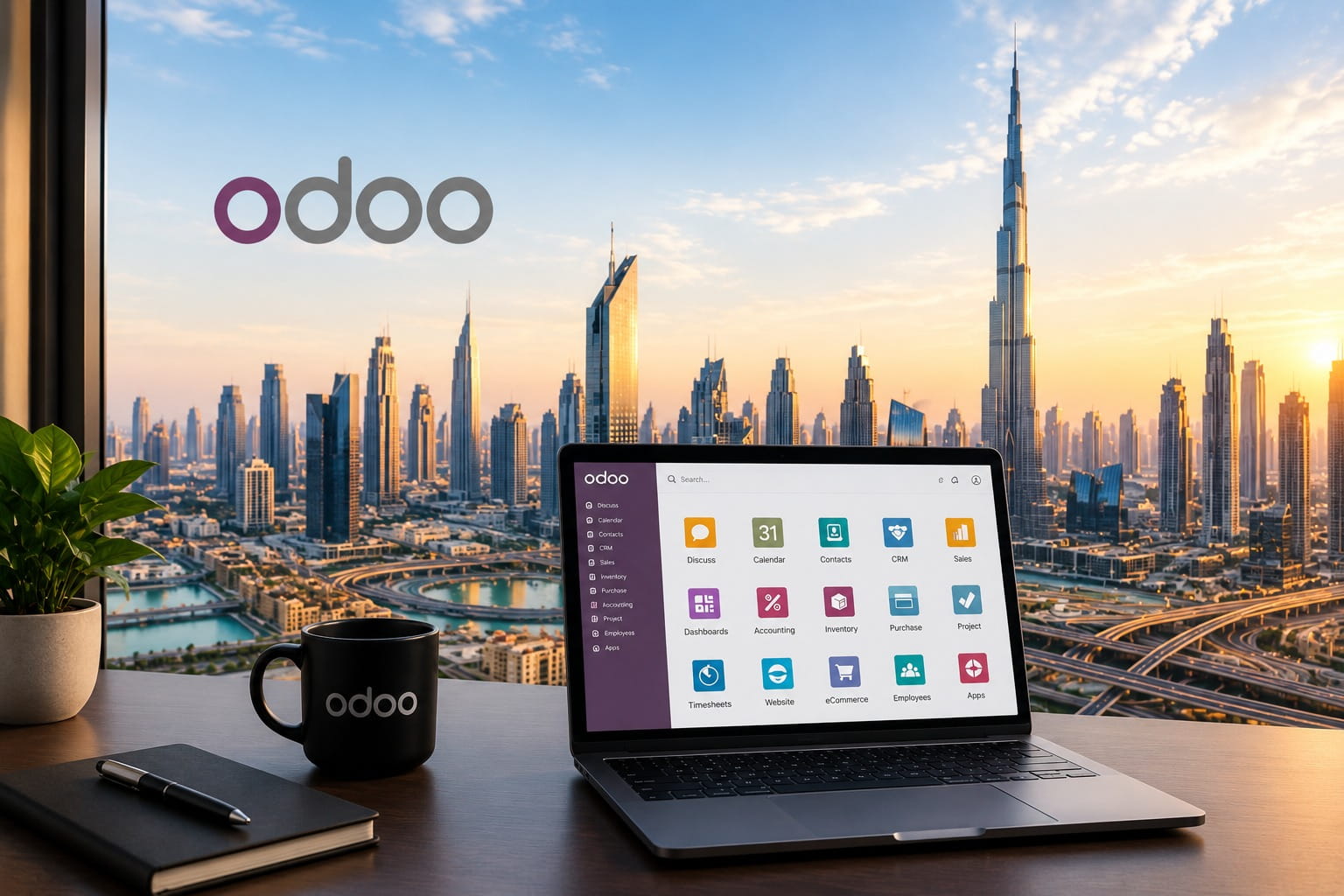
Dubai has always been a market where businesses have to move quickly. As companies grow, their day-to-day operations also become more complicated. Finance, sales, inventory, customer management, HR, e-commerce and reporting all need to work smoothly together.
In 2026, another factor is making businesses rethink their existing software: the UAE’s changing digital and regulatory environment.
E-invoicing, corporate tax, growing online sales, automation and expansion across the GCC are encouraging many companies to look more closely at ERP platforms such as Odoo. Instead of managing different departments through separate applications and spreadsheets, businesses are looking for a system that keeps important information connected.
Odoo is attracting attention because it can bring many of these business functions together in one platform. But the decision to move to Odoo is not simply about replacing an old accounting system. For many companies, it is about finding a better way to manage growth and have clearer control over their operations.
UAE E-Invoicing Is Pushing Companies to Review Their ERP Systems
One of the biggest reasons businesses are looking at their ERP setup in 2026 is the UAE’s e-invoicing programme.
E-invoicing is not the same as sending a PDF invoice through email. The UAE system is based on structured electronic invoice data that must be exchanged through the required framework. A scanned invoice, image, Word document, or ordinary PDF does not qualify as an e-invoice.
The rollout is being introduced in phases. Businesses with annual revenue of AED 50 million or more have an ASP appointment deadline of October 30, 2026, followed by mandatory implementation from January 1, 2027. Businesses below AED 50 million have a March 31, 2027 ASP deadline and a July 1, 2027 implementation date.
That makes 2026 an important year for preparation.
Businesses need to look beyond the invoice itself. Customer details, supplier information, tax settings, product data, accounting records and approval processes all need to be in good shape.
Odoo already provides a UAE-specific accounting localization, including a local chart of accounts, VAT configuration, corporate tax reporting features and UAE-specific invoice options. But businesses still need to plan the e-invoicing connection and work with the appropriate service provider.
Corporate Tax Makes Reliable Financial Data More Important
Corporate tax has also changed the way businesses think about their accounting systems.
Companies need accurate records and a clear understanding of their financial transactions. Revenue and expenses must be properly classified, while businesses also need to pay attention to imports, exports, reverse-charge transactions, credit notes, and audit trails.
This is where an integrated ERP can be useful.
Odoo’s UAE localization provides tools for local accounting and tax reporting, but installing the localization does not automatically make every business compliant. The system still needs to be configured according to the company’s actual operations and reviewed properly.
For example, a business may have multiple branches, projects, or legal entities and need to understand profitability across each one. Having this information in one system can make financial reporting much easier.
The important point is that technology supports compliance; it does not replace professional tax advice.
Companies Want to Move Away From Disconnected Software
Many businesses do not start with one large ERP system. Instead, they gradually add different tools as they grow.
Accounting might be handled in one application, customer information in a CRM, inventory in spreadsheets, online orders on an e-commerce platform, and employee information somewhere else.
The problem usually appears later.
Employees may have to enter the same information more than once. Inventory figures can differ between systems. Finance teams may wait for information from other departments. Management may also spend hours bringing data together just to understand what is happening across the business.
Odoo takes a more connected approach. Its applications cover areas such as accounting, sales, purchasing, inventory, manufacturing, POS, e-commerce, CRM, projects and HR.
For a growing company, this can make a noticeable difference. A customer order can move through sales, delivery, invoicing, payment and accounting without employees having to repeatedly enter the same information into separate systems.
E-Commerce Is Increasing the Need for Better Integration
Dubai’s e-commerce sector is another reason companies are paying more attention to integrated ERP systems.
Customers now expect more from businesses. They want convenient payment options, quick delivery, accurate stock information, easy returns and timely updates about their orders. UAE e-commerce research also points to continued growth in retailer websites, marketplaces, mobile apps, home delivery and AI-powered shopping experiences.
Delivering this kind of experience requires more than a well-designed website.
The online store needs to communicate with inventory. Inventory needs to connect with purchasing and warehouses. Orders need to reach fulfilment teams, while payment and sales information needs to reach finance.
Odoo can help connect these areas. For retailers and online businesses, this can provide better stock visibility, smoother order processing, easier return management, and a clearer view of profitability.
Odoo Gives Growing Dubai Businesses More Flexibility
Dubai businesses often operate through different structures. A company may have a mainland entity, a free-zone company, several branches, warehouses, or regional operations.
Some businesses also use Dubai as a base for expansion into Saudi Arabia, Oman, Bahrain, Qatar, or Kuwait.
As a company expands, its ERP needs to handle more than one company or currency. Intercompany transactions, separate tax requirements, inventory transfers and country-specific reporting can all become part of the picture.
Odoo’s localization approach can support this type of structure, although businesses should not assume that one setup automatically covers every GCC country. Each market has its own tax and compliance requirements.
This is one area where odoo integration services in the UAE can be valuable. Instead of simply installing the ERP, an experienced implementation team can help connect Odoo with the systems a company already uses and design the setup around its actual business operations.
Odoo Fits Different UAE Industries
Another reason for Odoo’s appeal is its flexibility across industries.
Retail and e-commerce businesses can connect POS, websites, inventory, purchasing, and accounting while monitoring stock accuracy and returns.
Wholesale and distribution companies can manage the flow from quotation and credit approval through stock reservation, delivery, invoicing, and payment collection.
Manufacturers can connect bills of materials, production planning, work centres, quality checks, maintenance, raw materials, and finished-goods costing.
Construction companies can use project budgets, purchase commitments, subcontractor costs, timesheets, retention, progress billing, and project profitability tracking.
For restaurants and F&B businesses, Odoo simplifies the management of sales, ingredient costs, procurement, stock, and wastage, while helping track the financial performance of each outlet more effectively.
Professional services companies can connect leads, proposals, projects, timesheets, expenses, milestones, retainers, invoices, and collections.
The key is that an Odoo implementation should be designed around the company’s actual business processes rather than simply activating every available module.
Integration Matters More Than a Good Software Demo
An ERP can look impressive during a demonstration. The real question is how well it works once it becomes part of the company’s everyday operations.
A Dubai business may need Odoo to connect with:
- Banks and payment gateways
- POS systems
- E-commerce websites
- Online marketplaces
- Courier and logistics platforms
- Payroll and WPS processes
- CRM and marketing tools
- Document management or signing platforms
- Business intelligence tools
- UAE e-invoicing providers
This is why companies searching for odoo integration services in uae should look beyond the software demonstration.
Before choosing a partner, ask which integrations they have experience with, whether an integration is standard or custom-built, how errors will be handled, and how the integration will be maintained when the ERP is upgraded.
Too Much Customization Can Create Problems
Odoo is flexible, but that does not mean every part of the system should be customized.
Businesses sometimes try to reproduce every old process inside the new ERP. A spreadsheet-based approval process, for example, may have worked for years, but that does not necessarily mean it should be rebuilt exactly the same way in Odoo.
Too much customization can increase maintenance work and make future upgrades more difficult.
A better approach is to use standard Odoo features wherever possible and customize only when there is a clear business reason to do so.
Clean Data Is Essential Before Moving to Odoo
Software is only as useful as the information inside it.
If a company moves duplicate customer records, incorrect VAT numbers, outdated products, wrong stock quantities, or old tax information into Odoo, the new system will not solve those problems.
Before migration, businesses should review customer and supplier records, products, stock, tax categories, opening balances, bank information, warehouse data, and other important master data.
Taking the time to clean this information before the migration can prevent many problems after the system goes live.
How Can a Dubai Business Prepare for Odoo?
A successful Odoo project should begin with the business, not with the software.
Start by identifying what is not working well in the current setup. Maybe invoices take too long to process, inventory figures are unreliable, or employees spend too much time moving information between systems.
Next, review the company’s requirements around VAT, corporate tax, free-zone operations, payroll, WPS, GCC activities, and e-invoicing.
Then decide how information should flow through the business and which system should be the main source of truth for customers, products, sales, invoices, payments, and reporting.
Data should be cleaned before migration, and important workflows should be tested before the full rollout. Businesses can start with processes such as quote-to-cash, warehouse operations, project billing, or e-invoice generation.
Finance teams, sales staff, warehouse employees, managers, and HR teams will all use the system differently.
Final Thoughts
For many Dubai businesses, 2026 is a good time to rethink how they manage their daily operations. With e-invoicing, tax requirements, growing e-commerce, and regional expansion becoming more important, having separate systems for every task can create unnecessary complications.
Odoo offers a way to bring these processes together in one place. But choosing Odoo is only the first step. The right setup, clean data, useful integrations, and proper implementation are what make the system valuable.
For businesses considering odoo integration services in the UAE, the focus should be on finding a solution that fits their actual needs and supports future growth. When implemented properly, Odoo can help Dubai companies work more efficiently, stay better organised, and make faster business decisions.