

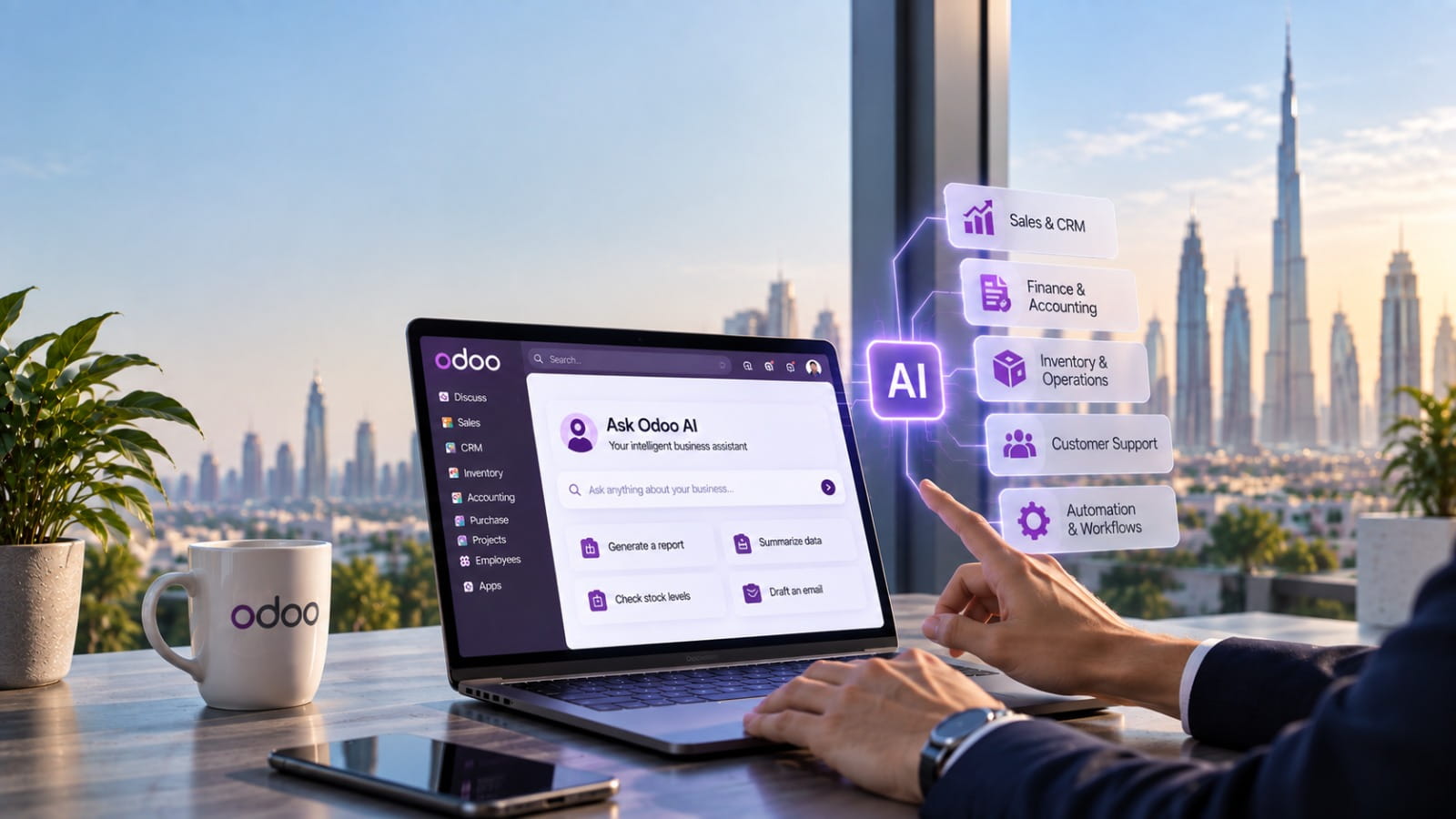
Artificial intelligence is changing how businesses interact with their ERP systems. Instead of relying entirely on menus, filters, reports and manual data entry, employees can increasingly use natural-language instructions to retrieve information, generate content, summarise records and support routine workflows.
In 2026, Odoo’s AI capabilities are moving beyond basic writing assistance towards AI agents, contextual assistance, natural-language queries, source-based responses, and workflow automation. For UAE businesses, this creates opportunities to connect sales, finance, customer service, inventory, marketing and operations more intelligently.
For companies considering Odoo integration services in UAE, the key question is not simply whether AI is available. It is how AI can be integrated into existing business processes while maintaining data quality, security, human oversight and UAE-specific compliance.
What Are the Key Odoo AI Features in 2026?
Odoo’s current AI capabilities include Ask AI, AI agents, contextual assistance, AI-powered writing tools and configurable automation. Ask AI allows users to interact with their Odoo database using natural language, while customised agents can work with defined instructions, tools and information sources.
For example, instead of manually searching through CRM records, a sales employee could ask:
“Which opportunities in Dubai have had no sales activity for the last three weeks?”
AI can help retrieve and interpret the relevant information, depending on the configuration and permissions of the Odoo environment.
AI agents take this further. Odoo’s documentation explains that agents can be configured with topics, tools, prompts and sources, allowing them to perform specific tasks rather than simply generate conversational responses.
AI-powered content and communication
Odoo AI can also assist with drafting emails, improving text, summarising discussions, creating internal content and preparing customer communications.
For UAE companies, these capabilities can be particularly useful when communication needs to support English and Arabic, different customer segments, GCC markets and locally relevant terminology.
How Odoo AI Can Support Different Business Functions
Sales and CRM
AI can help sales teams summarise customer histories, identify inactive opportunities, draft follow-ups and prepare information before meetings.
An Odoo CRM integration can become more valuable when customer data, sales activities, quotations and communication records are connected. Instead of switching between multiple systems, teams can work from a more complete customer context.
However, sensitive decisions such as discounts, credit approvals, contractual commitments, or government tender requirements should remain subject to human approval.
Finance and Accounting
AI can support invoice-data extraction, expense categorisation, payment-status queries, duplicate detection, reporting and exception identification.
Odoo’s UAE localisation includes VAT and corporate-tax reporting capabilities, local tax configuration, fiscal positions and a UAE-specific chart of accounts.
This does not mean AI replaces accountants or tax professionals. Businesses still need appropriate configuration, review procedures and professional advice for their specific tax circumstances.
Customer Service
AI agents can work with approved knowledge sources such as product documentation, FAQs, policies and internal knowledge articles. This can help classify enquiries, summarise tickets, suggest responses and route issues to the appropriate team.
For UAE businesses, bilingual support can also be valuable. AI-generated Arabic communication should still be reviewed by fluent users to ensure that terminology, tone and meaning are appropriate for the customer and industry.
Inventory and Operations
For distributors, retailers, manufacturers, and logistics businesses, AI can assist with stock searches, low-inventory identification, supplier performance analysis, delayed shipment monitoring and demand-related insights.
These applications become particularly valuable when an ERP connects multiple warehouses, suppliers, sales channels and locations. But the quality of AI recommendations depends heavily on the underlying ERP data. Duplicate SKUs, incorrect units of measure, outdated supplier information or inaccurate stock quantities can produce unreliable results.
Why Odoo Integration Matters for AI Adoption
AI delivers greater value when it can work with the systems and information a business already uses.
This is where Odoo integration services in UAE become important. Businesses may need to connect Odoo with websites, eCommerce platforms, payment systems, logistics applications, customer communication tools, third-party APIs and other business software.
A properly planned Odoo AI integration should consider:
- Which business process is being automated
- What data the AI can access
- Which systems need to communicate with Odoo
- What permissions the AI requires
- Where human approval is necessary
- How actions are logged and reviewed
- How sensitive information is protected
The objective should not be to automate everything. A better approach is to identify repetitive, measurable processes where AI can reduce manual effort without creating unnecessary operational risk.
UAE E-Invoicing and AI: Why Data Quality Matters
The UAE’s e-invoicing programme makes structured and accurate financial data increasingly important. The Ministry of Finance defines an e-invoice as structured invoice data exchanged electronically; a PDF, image, scan, Word document or invoice email alone does not qualify as an e-invoice.
The Ministry also maintains a list of accredited e-invoicing service providers, which is updated periodically.
For Odoo users, this means ERP integration should be planned around accurate customer, supplier, product, tax, currency and invoice information. AI can assist with processing and analysis, but businesses should not allow automated systems to change sensitive financial or tax information without appropriate controls.
The Biggest Challenge: AI Needs Reliable Data
One of the most overlooked aspects of Odoo ERP automation is data preparation.
AI cannot compensate for poorly maintained master data. Before introducing advanced automation, businesses should review:
- Customer and supplier records
- Product names and SKUs
- Units of measure
- Tax configurations
- Duplicate records
- Historical data
- User permissions
- Internal documentation
Odoo’s AI agents can also be restricted to approved information sources, helping organisations create more controlled, source-based responses.
A Practical Way to Start With Odoo AI
Businesses do not need to transform their entire ERP environment at once.
A practical implementation can begin with low-risk, read-oriented use cases such as information retrieval, summarisation, report assistance, ticket classification and content drafting. Once accuracy has been evaluated, businesses can introduce human-approved actions such as creating draft leads, preparing quotations or generating internal tasks.
Only after sufficient testing should organisations consider automating repetitive, reversible, low-impact activities.
What Businesses Should Expect Next
Odoo’s AI direction is increasingly focused on moving from AI that answers questions to AI that can assist with business actions. Odoo Experience 2026 is scheduled for September 24–26, with the opening keynote set to unveil Odoo 20 on September 24.
For UAE companies, this makes AI-enabled ERP, Odoo integration, workflow automation, data governance, cybersecurity and multilingual business processes important areas to evaluate as their digital systems evolve.
The businesses that benefit most from Odoo AI will not necessarily be those that automate the largest number of tasks. The focus should be on reliable data, well-designed processes, controlled permissions, measurable outcomes and appropriate human oversight.
Conclusion
Odoo AI in 2026 represents a shift towards more intelligent and connected ERP operations. From CRM and customer service to finance, inventory and reporting, AI can reduce repetitive work and make business information easier to access.
For UAE organisations exploring Odoo integration services in UAE, successful implementation starts with business processes rather than technology alone. Clean data, secure integrations, UAE localisation, e-invoicing readiness, bilingual communication and human oversight should form the foundation of any AI-enabled Odoo strategy.