

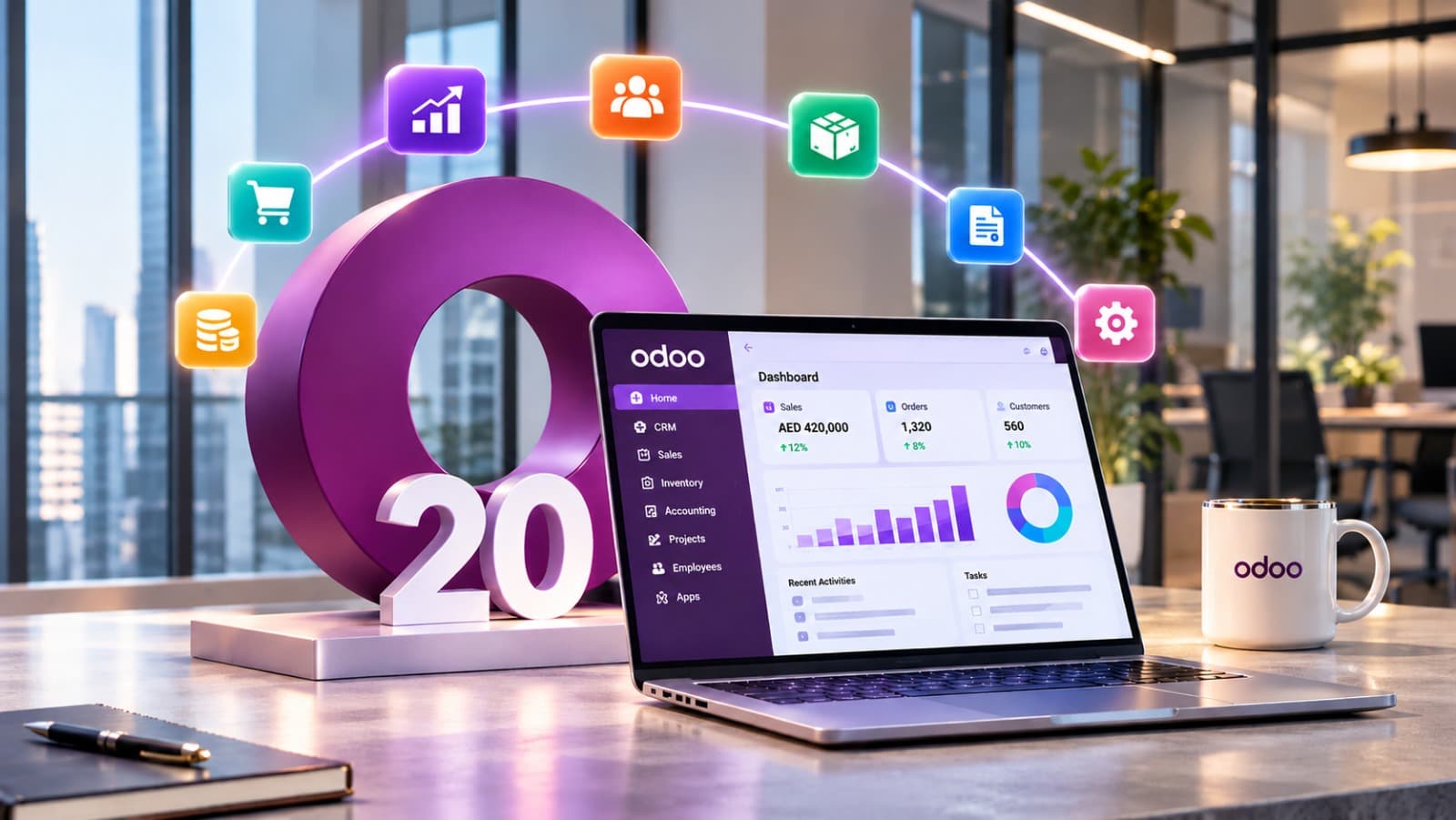
Choosing an ERP system is an important decision for businesses operating in the UAE. A company that starts out with separate tools for accounting, stock, payroll and customer records usually finds those tools pulling in different directions once it grows. What it needs is a single connected platform: one that shows what is happening across the business, supports compliance and gives managers something solid to base decisions on.
Odoo 20 is the latest release, and a handful of its changes deserve attention. The main ones are AI-powered automation, accounting improvements, inventory management and a set of operational tools. No company will use all of them. The sensible approach is to pick the updates that match problems the business already has, because that is where the real return comes from.
Businesses in Dubai and elsewhere in the UAE can use these updates to judge whether an ERP upgrade, or simply better system integration, would make daily work easier. Those who want Odoo to sit comfortably alongside the applications they already run can turn to professional Odoo integration services in UAE, so that every system exchanges data properly and meets the company’s operational requirements.
How Does Odoo 20 Support UAE Accounting and Tax Requirements?
VAT and Corporate Tax leave very little room for error in UAE accounting. Odoo 20’s UAE fiscal localisation addresses this with a regional setup that covers local reporting and day-to-day financial management. The official Odoo UAE fiscal localisation documentation spells out the accounting, tax and reporting configurations included.
Here is what the localisation provides:
- UAE Chart of Accounts: a ready-made structure that follows IFRS and local reporting requirements.
- VAT Configuration: preconfigured tax groups and fiscal positions covering the relevant UAE VAT treatments.
- VAT Reporting: structured reports that make tax return preparation easier.
- Corporate Tax Reporting: reports designed around UAE Corporate Tax requirements.
- Multi-Currency Management: support for transactions in more than one currency.
For finance teams, this means more uniform records and less manual work. A caveat applies, though. Reports are only as reliable as the tax setup, the way transactions are classified and the data feeding them, and all three need regular maintenance.
Companies moving from an older Odoo version should treat the chart of accounts review and the mapping of historical balances as part of the migration itself. A structured Odoo implementation approach helps configure the right modules around a company’s financial and operational needs.
Can AI Agents Make Business Operations More Efficient?
AI agents are among the most visible changes in Odoo 20. Previous AI features were largely limited to suggestions. Now a business can configure an agent to complete a defined task across connected applications and workflows.
Typical uses include responding to incoming sales enquiries, updating CRM records, drafting purchase orders and clearing repetitive admin jobs. Companies that run several departments, branches or customer accounts across the UAE stand to gain the most from this kind of support.
Less routine work and better coordination between teams are the obvious benefits. Controls matter, however. Agents should operate within clear permissions and approval steps, and anything involving financial transactions, payroll changes or other sensitive decisions needs sign-off from an authorised person.
Smarter Inventory and Procurement Management
Stock is a constant pressure point for trading, retail, distribution and e-commerce companies in the UAE. Replenishment that arrives late, stock records that do not match the shelf and surplus inventory all drain cash flow and weaken customer satisfaction.
Odoo 20 brings improvements that support better purchasing and stock decisions. Inventory and procurement workflows can now handle:
- AI-assisted purchase order preparation
- Suggested minimum and maximum stock levels
- Supplier quality checks
- Automated vendor bill matching
- Shipment and inventory monitoring
Purchasing teams can use these tools to see what needs reordering and to manage supplier tasks with less effort. Take a distributor supplying both Dubai and Abu Dhabi, holding stock in several warehouses and receiving imports on different lead times. A connected ERP lets that business see stock movements, purchasing needs and open orders in one place.
Automated recommendations work best as a first draft. Before placing orders, purchasing teams should compare them with seasonal demand, supplier reliability and what is actually selling.
AI-Assisted Accounting and Financial Visibility
Anyone who has worked in a finance department knows how much time goes into reviewing transactions, chasing receivables and hunting for reconciliation differences. Odoo 20’s AI-supported accounting features can assist with financial queries, cash-flow analysis and reconciliation work.
For UAE businesses on a growth path, that makes outstanding payments and expenses easier to track and overall performance easier to read. Gathering figures from separate systems takes up less of the day, which leaves finance teams free to study the results and deal with anything unusual.
AI-generated insights still need to be checked against the accounting records. Validating reports and approving accounting decisions stay with financial professionals.
Better Sales, CRM and Customer Experience
UAE customers expect things to be convenient, replies to be quick and service to feel the same whether they shop online or in person. Meeting that standard depends on reliable information about interactions, orders, payments and delivery commitments.
Odoo 20 continues to expand its customer-facing applications, among them CRM, sales, Point of Sale and eCommerce. The notable additions are:
- Automated lead assignment
- Multi-currency POS payments
- Flexible sales workflows
- Customer portal improvements
- Online order and delivery management
- Connected customer information
Retailers and service providers gain a lot from linking CRM, sales, inventory and accounting, because the information gaps that usually appear between departments start to close. A well-configured CRM system adds to this by keeping customer records tidy, tracking sales opportunities and making follow-ups easier to manage.
Businesses that sell into several markets should also go through their language settings, pricing, VAT treatment and communication templates. The system needs to reflect how the company really operates.
What Should UAE Businesses Consider Before Upgrading?
Feature count should not be the reason to upgrade. Business needs should. Before moving to Odoo 20, a company should look closely at its current Odoo version, installed applications, custom modules and third-party integrations.
Data deserves the same attention. Customer, supplier, product and employee records need reviewing, and accounting balances and tax configurations need proper validation. Sales, purchasing, inventory, payroll and accounting workflows should all be tested in a separate environment before the system goes live.
A phased rollout backed by staff training and thorough testing keeps disruption to a minimum. Companies thinking about a version upgrade can also read about when to migrate to a newer Odoo version before they map out the transition.
Conclusion
Odoo 20 offers useful developments for UAE businesses, particularly in AI-powered automation, accounting, inventory management and customer relationship management. However, the most valuable features are those that address actual operational requirements rather than simply adding more software capabilities.
Before upgrading, businesses should assess their existing systems, prepare their data and identify the integrations needed to support local operations and regulatory requirements. With the right implementation approach, Odoo can provide a connected foundation for managing business activities and supporting future growth.
If your business is planning an ERP upgrade or looking to connect Odoo with its existing applications, Digitz Technologies can help. Our team provides Odoo integration services in UAE, helping businesses connect essential workflows, streamline operations and build an ERP environment that supports their evolving business requirements.