

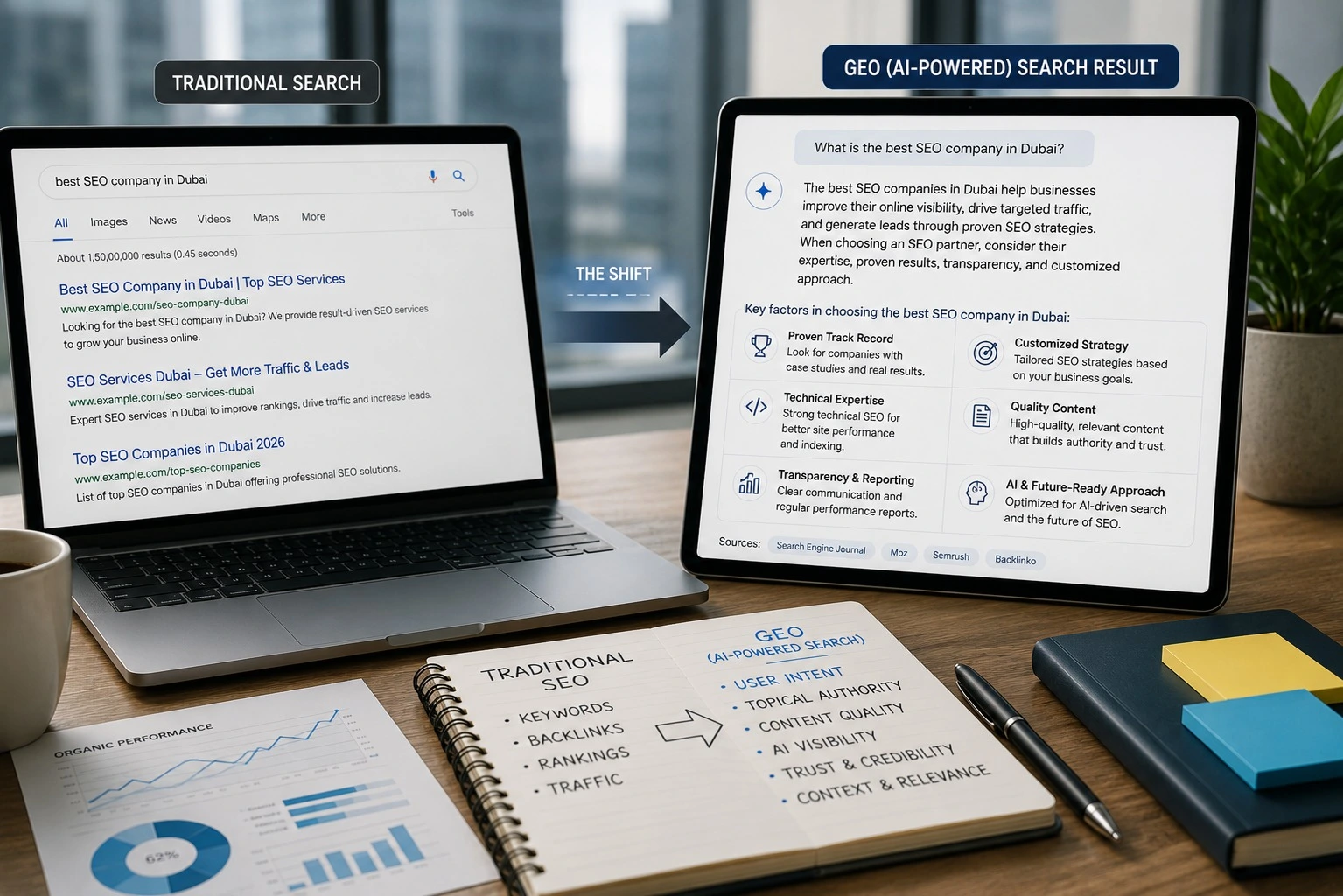
Search has always evolved, but the changes happening today are unlike anything businesses have experienced before.
For years, improving online visibility meant one thing—ranking higher on Google. Businesses invested in keyword research, technical SEO, backlinks, and quality content because appearing on the first page often translated into more website traffic and more enquiries. Those fundamentals still matter, but the way people search for information is changing.
Instead of clicking through multiple websites, users are increasingly asking detailed questions on AI-powered platforms like Google AI Overviews, ChatGPT, Gemini, Claude, and Perplexity. These tools don’t simply display a list of search results—they generate direct answers by analysing information from trusted and authoritative sources.
For businesses, this marks an important shift. Being visible online is no longer just about ranking well in search results. It’s also about becoming a source that AI platforms recognise, trust, and reference when answering users’ questions.
This is where Generative Engine Optimisation (GEO) comes into the picture.
Rather than replacing traditional Search Engine Optimisation, GEO builds on it. It focuses on helping businesses create content that performs well not only in search engines but also across AI-powered search experiences. For companies looking to stay competitive in the years ahead, understanding GEO is quickly becoming just as important as understanding SEO.
As AI-powered search continues to evolve, businesses working with an experienced SEO company in Dubai should begin preparing for this shift rather than waiting for it to become the standard. This guide explores what Generative Engine Optimization (GEO) is, why it matters, and how businesses can adapt their SEO strategies for the future.
Search Is Changing—And So Is Customer Behaviour
Think about the last time you searched for something online.
A few years ago, you probably typed a short phrase into Google, opened several websites, compared the information, and made a decision.
Today, that journey often looks very different.
Instead of searching for “SEO company Dubai,” someone might ask:
“Which SEO company in Dubai offers AI-ready SEO strategies for growing businesses?”
Rather than clicking through several websites, they may receive a detailed AI-generated answer within seconds.
This change is creating what many marketers describe as zero-click search experiences, where users get the information they need directly from AI-generated responses instead of visiting multiple websites.
That doesn’t mean websites are becoming less important. It simply means businesses need to think beyond rankings alone.
The goal is no longer just to appear in search results—it’s to become one of the trusted sources AI platforms rely on when generating answers.
For businesses that continue to focus only on traditional rankings, visibility may gradually become more challenging. Those investing in Generative Engine Optimisation, however, are better positioned to earn mentions within AI-generated responses, strengthening their authority long before a potential customer lands on their website. As AI-powered search continues to evolve, trust, relevance, and expertise are becoming just as valuable as keyword rankings.
What Is Generative Engine Optimisation (GEO)?
At its core, Generative Engine Optimisation (GEO) is the practice of creating and structuring content so AI-powered search engines can easily understand, evaluate, and reference it when generating answers.
Traditional SEO focuses on helping webpages rank higher in search results.
GEO focuses on helping your expertise become part of the answer itself.
Although the objective is different, GEO doesn’t replace SEO. Instead, it expands on many of the same principles while adapting them to the way AI search engines process information.
Modern AI platforms don’t rely solely on keywords. They analyse context, relationships between topics, credibility, and the overall quality of information before deciding which sources to reference.
That’s why successful GEO strategies focus on creating content that is:
- Well-structured and easy to navigate
- Written around complete topics rather than isolated keywords
- Supported by accurate and trustworthy information
- Rich in practical insights and genuine expertise
- Designed to answer real customer questions
As AI search becomes increasingly conversational, businesses that create helpful, experience-driven content are more likely to become trusted sources across both traditional search engines and AI-powered platforms. This evolution from keyword-focused optimisation to topical authority is becoming one of the defining characteristics of modern AI SEO strategies.
SEO and GEO: Working Together, Not Against Each Other
One of the biggest misconceptions surrounding GEO is that it will replace traditional SEO.
In reality, the opposite is true.
A strong SEO foundation is still essential. Search engines need to crawl your website, understand its content, and evaluate technical factors such as page speed, mobile usability, internal linking, and overall user experience.
GEO builds on those fundamentals.
While SEO helps search engines discover your content, GEO helps AI platforms understand whether that content is trustworthy enough to include in their responses.
Instead of viewing them as separate strategies, it’s more accurate to think of them as two parts of the same process.
SEO helps people find your website.
GEO helps AI recommend your expertise.
Businesses that combine both approaches are better prepared for the future of search, where visibility depends not only on rankings but also on authority, context, and credibility.
Why GEO Matters More in 2026 Than Ever Before
Artificial Intelligence isn’t simply changing search engines—it’s changing how people make decisions.
Customers are asking longer, more specific questions because AI platforms can understand natural language far better than traditional search queries.
Instead of searching for:
“SEO Dubai”
They now ask:
“Which SEO company in Dubai provides AI-ready SEO services for B2B businesses?”
AI engines evaluate multiple trusted sources before generating a response.
If your content isn’t written in a way AI systems can easily interpret, your business may never become part of that conversation.
This is especially relevant for companies operating in the UAE, where digital transformation and AI adoption continue to accelerate across industries. Businesses investing in SEO services in Dubai are no longer preparing only for Google’s search results—they’re preparing for a future where AI-powered search engines influence how customers discover, compare, and trust brands online.
How to Build a Website That’s Ready for AI Search
Understanding GEO is one thing. Applying it effectively is where businesses begin to see long-term value.
Unlike traditional SEO, where success was often measured by rankings alone, GEO focuses on making your content easy for AI systems to understand, trust, and reference. That doesn’t require starting from scratch—it means refining how your content is created and structured.
Here are some practical ways businesses can prepare for the future of search.
1. Write for People First, Then for AI
One of the biggest misconceptions about AI-powered search is that content should be written specifically for machines.
In reality, AI platforms are designed to identify content that genuinely helps people.
Instead of creating pages packed with keywords, focus on answering the questions your audience is already asking. Clear explanations, practical examples, and well-organised information make your content easier for readers to understand—and easier for AI systems to interpret.
Simple improvements such as descriptive headings, concise paragraphs, comparison tables, FAQs, and logical formatting can significantly improve how your content is understood across both traditional search engines and AI-powered platforms.
The goal isn’t to impress algorithms. It’s to create content that earns trust because it’s useful, accurate, and easy to follow. Those qualities are exactly what AI-powered search platforms look for when selecting information to include in their responses.
2. Build Expertise Around Topics, Not Individual Keywords
For years, SEO strategies often centred around ranking a single page for a single keyword.
That approach is becoming less effective as AI search continues to evolve.
Modern AI platforms look beyond individual pages. They assess whether a website demonstrates genuine expertise across an entire subject.
For example, an SEO company in Dubai shouldn’t only publish one article about SEO. It should build a connected library of content covering related topics such as:
- Technical SEO
- Local SEO
- Search Intent
- Google AI Overviews
- E-E-A-T
- Content Strategy
- AI SEO
- Generative Engine Optimisation
When these articles are linked together naturally, they create a strong topical cluster. Over time, this helps search engines and AI platforms recognise your website as a trusted source rather than just another page targeting a keyword.
3. Trust Is Becoming Your Strongest Ranking Signal
People trust businesses that consistently share accurate, valuable information. AI platforms work in much the same way.
Before recommending a source, AI evaluates signals that indicate credibility and authority. That includes the quality of your content, how consistently your business information appears online, whether reputable websites mention your brand, and how well your expertise is demonstrated.
This is where E-E-A-T becomes even more important.
Publishing original insights, industry observations, practical guides, and real-world expertise helps build confidence with both users and search platforms. Businesses that rely on generic or repetitive content are less likely to stand out in AI-generated search experiences.
Simply put, authority isn’t built overnight. It’s earned through consistency, accuracy, and genuine expertise.
4. Help Search Engines Understand Your Website
Visitors experience your website visually. Search engines and AI systems don’t.
They rely on structured signals to understand what your business does, the services you offer, and how different pieces of content connect.
This is where structured data and schema markup become valuable.
Schema acts like a layer of context behind your website, helping AI systems identify important information more accurately.
Useful schema types include:
- Organization
- Local Business
- Service
- Article
- FAQ
- Review
While schema alone won’t guarantee AI visibility, it provides the clarity search platforms need to interpret your content correctly—an important step in any successful Generative Engine Optimisation strategy.
Why GEO Matters for Businesses in the UAE
The UAE continues to lead the region in digital innovation, with Artificial Intelligence becoming a key part of business transformation across multiple industries.
As customer behaviour evolves, businesses are seeing a noticeable shift in how people research products and services online. Instead of comparing dozens of websites, many users now rely on AI-generated summaries to shortlist providers before visiting a company’s website.
Imagine someone searching for:
“Which SEO company in Dubai can help businesses prepare for AI-powered search?”
Or:
“Which logistics company offers complete freight forwarding and customs clearance in Dubai?”
These aren’t simple keyword searches anymore. They’re conversational questions, and AI platforms generate answers by referencing businesses they consider credible and authoritative.
For companies offering SEO services in Dubai, this presents an opportunity to become part of those conversations—provided their content demonstrates expertise, relevance, and trust.
Common GEO Mistakes Businesses Should Avoid
As interest in GEO grows, many businesses rush to adopt AI tools without changing their overall content strategy.
That often leads to avoidable mistakes.
Some of the most common include:
- Publishing large volumes of generic AI-generated content.
- Focusing only on keywords instead of user intent.
- Ignoring E-E-A-T principles.
- Neglecting structured data.
- Allowing valuable content to become outdated.
- Maintaining inconsistent business information across online platforms.
AI search rewards quality over quantity. A smaller collection of well-researched, experience-driven articles often delivers better long-term value than publishing dozens of repetitive pages.
Measuring Success Beyond Rankings
For years, SEO success was measured by rankings and organic traffic.
Those metrics still matter, but GEO introduces a broader way of evaluating digital visibility.
Businesses should also monitor:
- Brand mentions within AI-generated responses
- Growth in branded searches
- Engagement and content quality metrics
- Organic traffic relevance
- Topical authority across key subject areas
These indicators provide a clearer picture of how your business is performing across both traditional search engines and emerging AI-powered search experiences. As search technology continues to evolve, measuring visibility beyond rankings is becoming increasingly important.
The Future of Search Is Already Taking Shape
Search is becoming more conversational, more intelligent, and more focused on delivering immediate answers.
That doesn’t mean traditional Search Engine Optimisation is disappearing.
It means SEO is evolving.
Businesses that continue investing in technical SEO, high-quality content, user experience, and topical authority will already have a strong foundation. Adding Generative Engine Optimisation simply prepares that foundation for the next generation of search.
Rather than choosing between SEO and GEO, successful businesses will combine both to improve visibility wherever customers choose to search.
Conclusion
The future of search isn’t about replacing traditional SEO—it’s about expanding it.
As AI-powered search engines become part of everyday decision-making, businesses need content that goes beyond rankings. They need content that demonstrates expertise, answers real questions, and earns the trust of both users and AI platforms.
Generative Engine Optimisation helps businesses make that transition. By combining strong Search Engine Optimisation practices with topical authority, structured content, and E-E-A-T principles, organisations can improve their visibility across both conventional search engines and AI-generated search experiences.
Businesses that embrace Generative Engine Optimisation alongside traditional Search Engine Optimisation will be better prepared for the future of digital search. By focusing on authoritative content, topical expertise, user intent, and AI-friendly optimisation, organisations can strengthen their online visibility and build lasting trust in an increasingly AI-driven search landscape.