

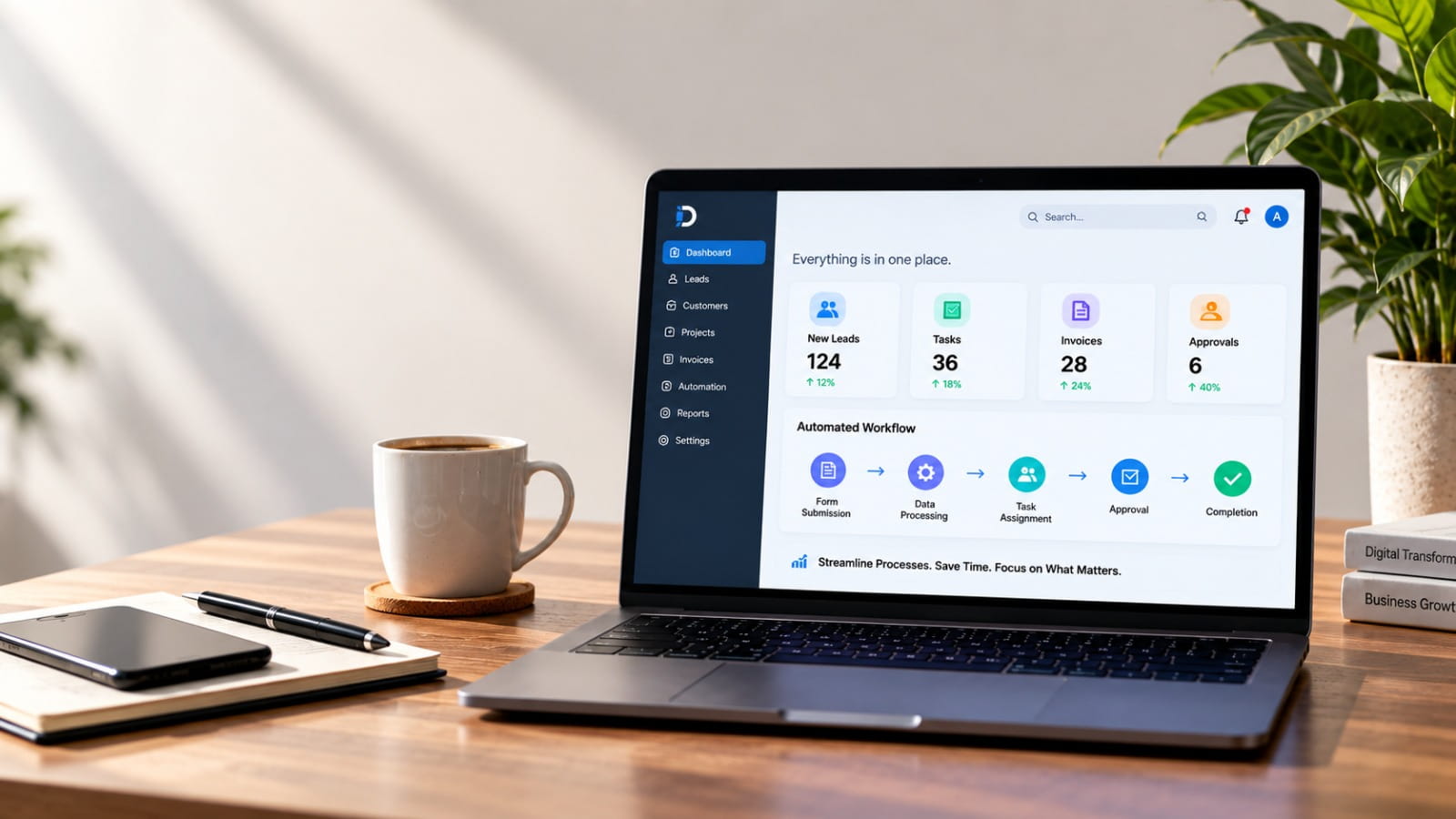
Web development has evolved far beyond creating simple websites. For modern businesses, a well-designed web platform can become part of the operational infrastructure that connects customers, employees, software systems and business processes.
In Dubai, where businesses across industries are rapidly adopting digital technologies, manual processes can create unnecessary delays and administrative workloads. Teams may spend valuable time copying leads into spreadsheets, responding to routine enquiries, preparing documents, tracking approvals, updating inventory or transferring information between disconnected systems.
Modern web development can help replace many of these repetitive activities with automated workflows, system integrations, customer portals and intelligent web applications. The goal is not simply to reduce the number of tasks employees perform, but to make business processes more connected, consistent and measurable.
For businesses evaluating a web development company Dubai has to offer, this means looking beyond website design and asking an important question: How can web technology make everyday operations more efficient?
Why Manual Processes Become a Business Challenge
Manual work often starts as a practical solution. A small business may use spreadsheets to manage leads, email to handle approvals and separate software for accounting or inventory.
As the organisation grows, however, these systems can become fragmented.
Employees may need to:
- Copy website enquiries into a CRM
- Re-enter customer information into different systems
- Track approvals through email or WhatsApp
- Update inventory manually
- Prepare recurring reports
- Create invoices and send them individually
- Follow up with customers about routine requests
- Check different systems before responding to customers
- Maintain multiple versions of the same information
Each task may appear manageable on its own. The larger problem is the cumulative time involved and the possibility of inconsistent or duplicated information.
Custom and low-code web applications can address this by creating a centralised data environment, configurable workflows and audit trails. The source material specifically identifies these capabilities as ways to reduce spreadsheet-based work, email chains and repeated data entry.
Automate Customer Bookings and Scheduling
Appointment-based businesses often depend on employees to answer calls, check availability and manually confirm bookings.
Clinics, salons, consultants, training providers and other service businesses can use booking-enabled web applications to allow customers to select available time slots directly.
A connected booking system can automatically manage:
- Appointment scheduling
- Availability
- Confirmation emails
- Reminder notifications
- Cancellations
- Rescheduling
- Internal staff notifications
Instead of an employee coordinating every appointment manually, the web application manages the routine steps while staff remain available for customer service and other important responsibilities.
This is particularly valuable when a business handles a high volume of bookings or operates across multiple locations.
Connect Websites With CRM and Business Systems
One of the most significant opportunities for business process automation comes from connecting systems that previously operated independently.
Consider a customer submitting an enquiry through a website.
In a manual workflow:
Website enquiry → Spreadsheet → Employee review → CRM entry → Sales assignment
With API integration, the process can become:
Website enquiry → CRM → Automatic assignment → Sales follow-up
The same principle can apply to ERP, accounting, inventory, helpdesk and other business platforms.
Modern web development services Dubai businesses use can include API-based integrations that allow systems to exchange information automatically.
This can help businesses achieve:
- Reduced duplicate data entry
- Faster lead distribution
- More consistent customer information
- Better reporting
- Fewer transfer errors
- Greater visibility across departments
For companies with specialised operational requirements, custom web development Dubai solutions can be designed around existing workflows rather than forcing the business to adapt completely to an off-the-shelf system.
Give Customers Self-Service Options
Not every customer request needs to be handled manually by an employee.
A customer portal can allow users to perform routine actions themselves, such as:
- Checking order status
- Downloading invoices
- Viewing account information
- Submitting support requests
- Uploading documents
- Updating selected information
- Tracking service requests
- Making payments
This creates a customer self-service portal that can reduce repetitive calls, emails and messages.
For example, instead of a customer contacting the support team to ask about an order, the customer can log in and view the latest status directly.
The benefit is not only reduced workload. Customers also receive faster access to information without waiting for an employee to respond.
Connect Multiple Customer Channels
Dubai businesses increasingly interact with customers through websites, WhatsApp, social media, marketplaces and traditional communication channels.
When these channels operate independently, customer information can become fragmented.
Web development can connect these touchpoints to a common backend so that information from one channel can trigger actions in another system.
For example:
Website enquiry → CRM → Sales notification → WhatsApp follow-up
Or:
Online order → Inventory update → Delivery notification → Customer portal
This type of omnichannel integration can reduce repetitive data entry and provide employees with a more complete view of customer interactions.
Support UAE Digital and Compliance Requirements
Automation in Dubai also needs to consider the UAE’s evolving digital and regulatory environment.
Electronic invoicing is one example. The UAE Ministry of Finance has announced a phased implementation of the national e-invoicing system. According to the Ministry, businesses with annual revenue of AED 50 million or more are scheduled for implementation from 1 January 2027, while businesses below AED 50 million are scheduled for 1 July 2027, subject to the applicable requirements.
This makes finance and accounting integration an increasingly important consideration for businesses planning their technology infrastructure.
Data protection is another key area. The UAE Personal Data Protection Law establishes requirements relating to personal-data processing and protection. Web applications handling customer, employee or business information therefore need appropriate security, access controls and privacy considerations.
Automation should not mean removing oversight. Instead, businesses should determine which processes can be automated completely and which require human approval.
Automate Industry-Specific Processes
Real Estate
Property businesses can connect lead capture, property information, CRM systems, tenant requests, documentation and payment workflows.
A property portal can reduce manual work involved in updating information and handling routine tenant or buyer requests.
Logistics and Supply Chain
Logistics businesses often handle large volumes of documentation, shipment information and delivery updates.
Web applications can connect customer portals with shipment tracking, warehouse systems and internal operations. Customers can then access tracking information without repeatedly contacting operations teams.
Retail and E-commerce
E-commerce businesses can connect:
Website → Order → Inventory → Payment → Delivery → Customer notification
Automated inventory synchronisation and post-purchase communication can reduce repetitive operational work.
Professional Services
Law firms, accounting companies, consultants and other professional-service businesses can use client portals to collect documents, organise onboarding information, manage approvals and support billing workflows.
Healthcare and Education
Portals can support appointment scheduling, document submission, payments and controlled information access, subject to applicable sector-specific requirements.
The common principle is to identify repetitive processes and connect them into one structured workflow.
AI Is Expanding What Web Applications Can Automate
AI is adding another layer to web-based automation.
Traditional automation generally follows predefined rules:
If X happens → perform Y.
AI-enabled applications can assist with more complex tasks such as:
- Document classification
- Information extraction
- Natural-language queries
- Customer support
- Data summarisation
- Internal knowledge retrieval
- Anomaly detection
For example, instead of an employee manually reviewing a large set of customer enquiries, an AI-enabled system could classify them and route them to the appropriate department.
However, AI should be introduced carefully. Businesses need reliable data, appropriate access controls, monitoring and human oversight for processes where errors could have significant consequences.
The Future of Web Development Is More Than a Website
Modern web development is increasingly becoming an operational layer that connects customers, employees, software systems and business processes.
For a Dubai business, the right digital platform can automate bookings, connect CRM and ERP systems, manage documents, support customer self-service, streamline approvals and create a central source of business information.
The most effective approach is not to automate every task simply because technology makes it possible. Instead, businesses should identify where manual work creates the greatest operational burden and then build technology around those specific needs.
For businesses considering a web development company Dubai market, the focus should therefore extend beyond visual design. The right development strategy should consider integrations, automation, scalability, security, user experience and measurable business outcomes.
Final Thoughts
Web development can do much more than create a professional online presence. For businesses in Dubai, it can become a practical tool for reducing repetitive work, connecting disconnected systems, improving customer experiences and giving teams better visibility into daily operations.
From automated bookings and CRM integrations to customer portals, document workflows, e-invoicing and AI-assisted processes, the right digital infrastructure can gradually replace unnecessary manual steps with connected and measurable workflows.
Businesses should first identify where time, data or efficiency is being lost, then choose the right combination of custom web development, API integration, workflow automation and business systems to address those bottlenecks.